
📖 The Pastor’s Attention
An Economy of Focus and Influence

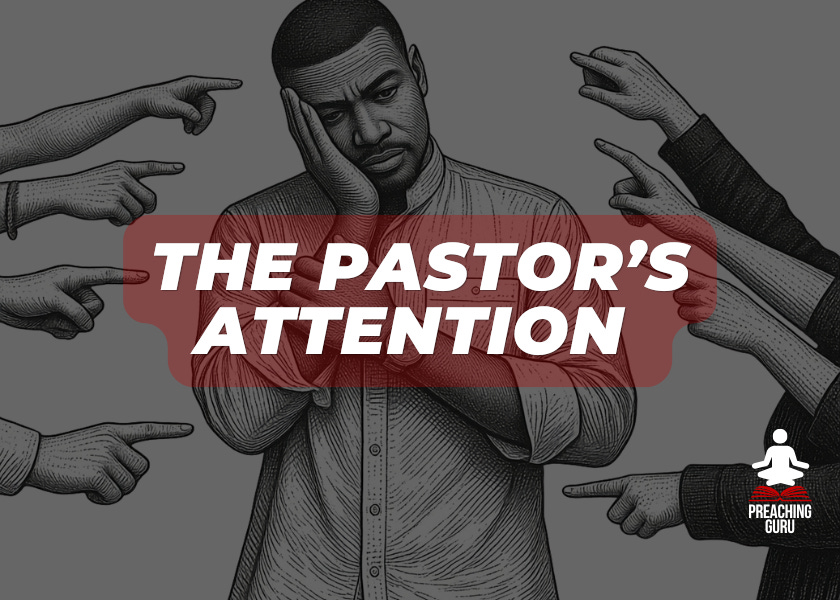
There is a quiet truth about pastoral leadership that few seminary classes name out loud. The pastor’s attention is the most-watched object in the church. What he turns toward. What he leans into. What he picks up first when he walks into the building on Monday morning. The saints are watching the pastor watch, and they are taking notes.
This is what makes distraction so dangerous in ministry. Distraction in a pastor is a pedagogical event. Whatever pulls his eyes pulls the church’s eyes after it. Let a budget dispute pull his eyes for three months, and the church learns that money is the work. Let a difficult member pull his eyes for a season, and the church learns that managing difficult people is the work. Let the gospel and the equipping of the saints and the reaching of the lost pull his eyes, and the church learns that this is the work. The pastor’s attention writes the curriculum that their people study.
This is why limited distraction is a discipline of stewardship — the kind a pastor will answer for one day. And like any discipline, it operates on two levels at once. The first level is volume. The second level is direction. Get them both right, and the work of God in your local church begins to compound. Get them wrong, and your people learn to amplify what you amplify and study what you study, no matter what you preach from the pulpit on Sunday.
Volume
The first half of the discipline can be summed up in one line:
Manage the church's business quietly; magnify the church’s ministry loudly.
Most churches have the volume knobs backward. The business gets the noise. The ministry gets the whispers. Listen to your next deacon meeting and track the conversation by minutes. How much time on the broken HVAC? How much time on the lawn vendor? How much time on the financial report? How much time on the lost soul, the discipleship gap, the equipping of leaders, and the proclamation of the gospel? The math tells you what your church is becoming. The business must be tended. Roofs leak. Staff need paychecks. Vendors need to be paid. The trouble comes when the church's maintenance work grows louder than its mission work. Quiet management is the discipline of handling the necessary in the lowest voice possible so that the essential can be heard. The pastor who has learned this carries themselves differently. They keep their composure when the air conditioner breaks. They save the pulpit for the gospel. They guard the parking lot conversation for the soul. They run the office in a whisper and preach the kingdom in a shout. Their people, watching them, learn what to amplify in their own lives.
Direction
The second half of the discipline can be said just as briefly:
What you point at, frequently, people focus on intently.
A pastor’s attention is the most influential pulpit in the church. Every announcement is a pointed finger. Every email is a pointed finger. Every prayer focus, every recurring sermon theme, every line that gets repeated in casual conversation, is a pointed finger. The people who love their pastor and trust them look where they point. This places the pastor under a quiet weight. Keep pointing at conflict, and your church becomes a conflict-aware church. Keep pointing at giving, and your church becomes a giving-conscious church. Keep pointing at the Great Commission, and your church becomes a missional church. The finger preaches whether the pastor knows it or not. Distraction shows up here as misdirected pointing. The distracted pastor points at whatever is loudest in their own week. The focused pastor points at what God has assigned them to point at, season after season, even when other things are louder. In the end, limited distraction is a pastor’s ability to keep pointing to the same right thing long enough for their people to actually see it.
The Economy
This is the pastoral attention economy. Two disciplines operating at once. Volume control with one hand. Direction control with the other. Whisper the necessary. Shout the essential. Point steadily at the gospel until the people learn the address. The world will not stop competing for your attention. The ministry will not stop sending you legitimate inquiries. The business of the church will not stop calling for your time. Your task is to lead with limited distractions so that what your people see you watch is worth being watched.
Shalom.