
📖 No Questions. No Sermon.
5 Principles for Investigating a Biblical Text.

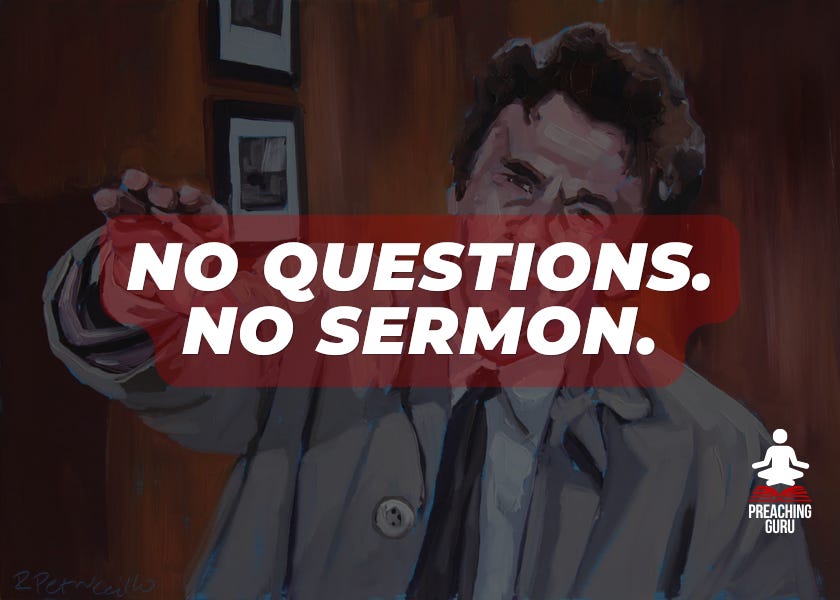
One of my favorite childhood shows was Colombo. Colombo was a detective show from the 1970’s. The main character was Lieutenant Columbo, a seemingly bumbling detective who would shuffle into a room, ask questions that appeared almost accidental, but those questions were never accidents. They were investigations. Every question served a purpose. Every answer moved him closer to truth. By the end, he had not just information. He had a case.
Preaching is the same. You cannot preach what you have not discovered. And you cannot discover what you have never questioned. The difference between a sermon and a lecture is simple: you can tell details, but you have to preach answers.
Here are five principles for digging into the details the way Colombo digs into a case.
One. Questions emerge from the text itself. Do not skim the surface. Be inquisitive. Dig deeper into what is underneath the words, behind the words. Read carefully. Ask: Why did the writer choose this word and not another? What assumption lives in this phrase? What tension exists between these two sentences? What does the text seem to be arguing against? These are not random questions. They come from the text. They demand that you read like an investigator, not a consumer. Once you have asked these questions of the text, then you ask questions about your people. What does my congregation need to hear? What does this passage assume about God that my people doubt? But it all starts with inquisitiveness. It all starts with refusing to take the surface as sufficient. Colombo never accepted the easy answer. He dug. You must dig too.
Two. The right questions narrow the field. Not all questions are equal. A random question wastes time. An exegetical question—one tied to your text and your congregation’s moment—that question cuts through the noise. It says: This matters. This is what we are investigating. When you ask the right question, everything else falls away. You know what to study. You know what to ignore. But here is what you need to know: the right questions will emerge from your reading. Do not be discouraged. Do not get weary thinking you will not ask the right questions. You are the one asking the questions. All of you is coming to bear in this moment. Your experience. Your study. Your prayer. Your knowledge of your people. Your sensitivity to the Spirit. When you read with intention, the right questions surface. Trust that. Trust yourself as an investigator.
Three. Answers must land on people. This is where most preachers fail. They discover an answer. They are proud of it. Then they announce it like a fact in an encyclopedia. But an answer that does not touch your people is not a sermon. It is information. Your answer must address them. It must move them. It must change how they see God, themselves, or their world. Here is the work: discovering information is one thing. Preaching answers is another. Once you have discovered the truth in the text, your calling as a minister is to build the bridge. You take that ancient truth and make it live in modern time. Not necessarily stylistically, but tactically and most importantly, reverently. You preach it at the right timing, in the right space, with the right words. Words that unlock understanding. Words that connect an ancient text to a contemporary heart. That bridge is not decoration. It is the sermon itself. Without it, you have information. With it, you have transformation.
